-
It’s boring
-
My class is too hard
-
I don’t like the teacher (teacher is mean)
-
I’m not good at ________ (subject)
-
I can’t concentrate in class
-
Homework
-
I never do good on exams, no matter how hard I try
-
I get in trouble for talking in class
-
I don’t like getting up early
-
I’m interested in other things than what they teach
Tag: Learning
-

10 COMMON REASONS WHY STUDENTS SAY THEY DON’T LIKE SCHOOL
-

FOR WHAT PURPOSE?
As adults, we often push our children (and students) in an effort to assist them to attain what we know to be their full potential.
We tell them that they “must” know/learn/achieve certain things in order to be able to be successful in the grown-up world. This advice often falls upon deaf ears.
Very often we grown-ups overlook a simple fact: an individual (no matter how old or young) must have their own purpose for knowing, learning and achieving something in order for it to be truly valuable and useful to them. It isn’t enough to be told a reason that they ought to have, such as a graduation requirement, they need to find their own reason, one that is in alignment with their personal goals and interests, in order for it to be purposeful for them.
Purpose is a prime motivational tool and driving force for any individual–even children. When you find someone who is chronically apathetic, lazy or disinterested about learning something, help them to find their purpose. How will knowing this thing be useful to them as an individual and assist them in their goals and aspirations?
It’s not always an easy task, but it does serve a larger purpose.
Contact us to learn more about solutions to improve student interest in learning.
-

TEACHING POINT #1 INTEREST & USE IN LIFE
If one wishes a subject to be taught with maximal effectiveness, he should:
#1. Present it in its most interesting form.
Find something about the subject matter that engages and holds the attention of the students at the appropriate age level. Correlate the subject to something they already know, admire or have strong interest in. Showcase the wow-factor!
- Demonstrate its general use in life.
How do people use this in everyday life? Not “other” people or “some” people, but real people they know and identify with.
- Demonstrate its specific use to the student in life.
What does this have to do with them? How could they use this in their life to accomplish their goals and why would they want to?
As an example, when teaching beginning handwriting to 4-year-olds, I would appeal to their desire to be more grown-up. I would show them my driver’s license, tell them what it was and then ask them if they would like to drive a car and have their own driver’s license one day. The answer was always a unanimous “yes!” I briefly explained how I used handwriting to get my license and that I was going to teach them how to write so they would be ready when the day came. You would be hard-pressed to find another classroom of children who were more eager and proud of letter formation and handwriting than my students were. It was interesting to them; they saw the general use of it in life and they all had a specific purpose in mind that they could use the information and skill – and it was fully aligned to their desire to be grown-up.
Teaching is so much more than just imparting information dictated by a curriculum — it sparks a desire to learn in each individual student and makes it personal to them.
-
TEACHING POINT #2 KEEP IT SIMPLE
If one wishes a subject to be taught with maximal effectiveness, he should:
#2. Present it in its simplest form (but not necessarily its most elementary).
Break down concepts into simple terms so even complex subject matter is presented into bite size pieces that can be easily understood. Doctors describe medical procedures in “laymen’s terms” exactly for this reason; so the patient doesn’t need a medical degree to understand what is happening and what to expect.
– Gauge its terms to the understanding of the student.
Use nomenclature appropriate for the age group, ability level and experience of the student and make sure to define any unfamiliar or new words and keep those definitions clear and simple for the student. Most likely, you’re not talking to a third grader who is ready to tackle their Master’s thesis.
– Use terms of greater complexity only as understanding progresses.
Use a gradient approach to teaching. As student understanding and ability is increased in the subject, you can then step up the game and introduce more and more complex concepts and nomenclature as their understanding progresses. Older students may not have fully gotten earlier concepts as expected and this is how you can gradually increase their knowledge and understanding.
Does this mean that subject matter and learning should be dumbed-down?
Absolutely NOT!
This is how to build the foundation for all future successful learning and application in a subject. Complex concepts don’t have to be presented in a way that seems difficult to learn or understand.
Keeping it simple and progressing at a pace that students can follow and build upon is how anything in life is mastered and how learning should be: fun, interesting and relatively easy.
Learn more about how Study Technology can assist you in your pursuit of effective education.
Effective Education Publishing is a division of Applied Scholastics International.
© 2019 Applied Scholastics International. All Rights Reserved. Applied Scholastics, the Applied Scholastics open book design and the Effective Education Publishing design are trademarks and service marks owned by Association for Better Living and Education International and are used with its permission. Applied Scholastics International is a non-profit educational organization and does not discriminate on the basis of race, color, religion, national origin, sex, disability or age in administering student admissions or any of its policies, programs or activities.
-

TEACHING POINT #3 KNOWING IMPORTANCES
If one wishes a subject to be taught with maximal effectiveness, he should:
#3. Teach it with minimal altitude (prestige).
Any good teacher will tell you that teaching isn’t about showing off how smart you are or making sure that your students respect you because you have multiple degrees and they don’t. Teaching is about helping others learn – imparting knowledge in a way that they can understand, can participate in and ultimately so they can demonstrate competence in using that knowledge for benefit in their own lives.
· Do not assume importance merely because of a knowledge of the subject.My high school calculus teacher was brilliant. Nerdy, but brilliant. He spent his summers writing our math books because he felt the existing math curriculum wasn’t as effective as it could be. He was knowledgeable, competent and completely unassuming – his objective was solely on how to best help his students learn tough concepts so they could apply them logically and successfully. He measured his importance by how well his students were doing in math and not by how much he knew about math.
· Do not diminish the stature of the student or his own prestige because he does not know the subject.It kind of goes without saying, but making less of someone because they do not know about something, does not actually help them to know – it usually just makes them feel bad. The Spelling Bee Champ floundering in geography is still an exceptional speller. Their brilliance in one area will inevitably spill over into other areas – with patience and encouragement.
· Stress that importance resides only in individual skill in using the subject and, as to the instructor, assume prestige only by the ability to use it and by no artificial caste system.Having knowledge about something isn’t the same as demonstrating effective skill to put that knowledge to use. Information is not the same as action. Perfect exam scores do not automatically translate into competence of practical application. Knowing the theory of how to read a map is very different from actually having to use one to successfully navigate your way out of the wilderness. As long as data is stressed to be the most important factor in learning, students will always be lacking in skill and ability in using information to actually solve the problems encountered in life.
Brilliant teachers are brilliant because they are able to raise the ability level of their students, not just their grade point averages.
Learn more about how Study Technology can assist you
in your pursuit of effective education.
-
GRADIENTS: ONE STEP AT A TIME
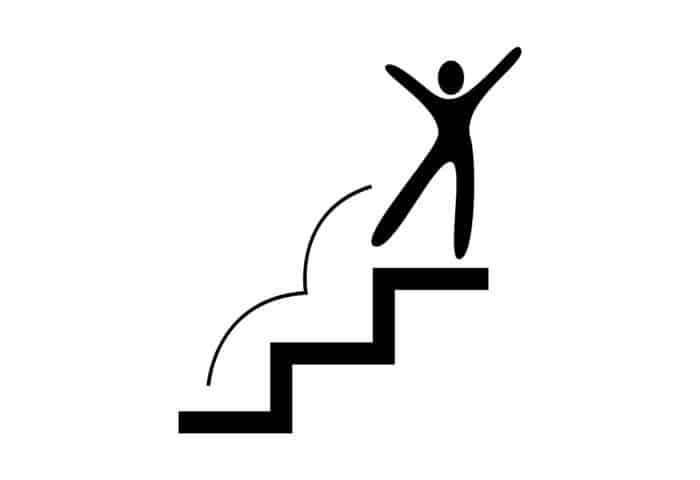
It’s a basic concept we are familiar with, tackling tasks one step at a time, only progressing to the next thing once we have mastered the current step. It’s essentially Skill Building 101 and when done properly a solid foundation is built and competency is the ultimate result. Conversely, when a gradient has not been mastered and one tries to move along, confusion ensues.You would never expect to build a second floor structure if the foundation for the ground floor was incomplete and shaky.Learning follows the same principle: solid foundation = competency and the basic structure to continue to build upon.When you find a student having difficulty in math, take a look at the previous step(s) and find out what they missed and get that addressed and fixed up. Problems with division typically track back to confusions and inability stemming back to multiplication and even subtraction. To focus on handling the division difficulty immediately present is to ignore the earlier source of the real difficulty.This simple approach applies to any subject and creates the solid building blocks necessary to learning, ability, confidence and competence. Learn more about the simple solutions Study Technology provides.
 -
Local Librarian Loves CLC Academy Students!
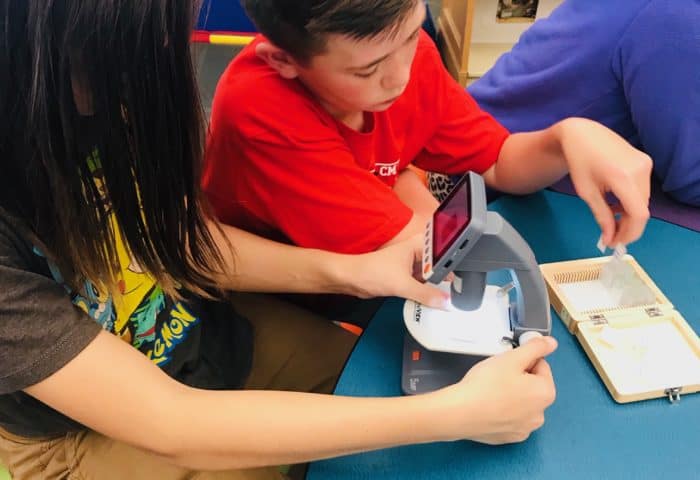
Recently, Ms. Sharon (4th/5th grade CLC Academy teacher) has been taking her class to the library in downtown Clearwater. Last week they got a “behind the scenes” tour of the library and they also discovered the library’s STEM projects. (STEM stands for Science, Technology, Engineering and Math.)
Today the class went and here is a Success Story that Sharon got from the Head Librarian of the Children’s Library.
“Our experience with CLC Academy has been extremely positive. Thestudents are actually engaged in our STEM based Discovery Studio under the guidance of the most patient and skillful teacher. She is attentive, watchful and ignites the curiosity of her students. It is exciting for us as librarians to observe youth learning all that their library has to offer.
One student, who has checked out three books on each occasion of visiting the library, brought his parent today so that he could get a full access library card.
Further, the teacher of this class took her students to our book sale and purchased a book for each student. She has previously purchased café cookies providing excellent practice for our special needs student who staff our café. I thank her for her generosity and support of our library.”